Woodneck Beach & Sippewissett Marsh
Additional Resources
Woodneck Beach (WNB) is one of ten public beaches owned and managed by the Town of Falmouth. For our Sippewissett constituency, from Palmer Avenue to Quissett Harbor, it is the only readily accessible public beach, and for many the only neighborhood access to the water’s edge. Each Town beach has its own special attraction; for Woodneck, it is the wild quality of the setting, with natural beach landforms, broad saltmarsh, the safe tidal inlet and creeks, along with an associated diversity of wildlife.
Woodneck Beach Dune Restoration
At Woodneck Beach, the coastal dunes serve as a barrier against flooding from high surf and storm surges, and they provide important wildlife habitat for rare species, including piping plovers and New England Cottontail rabbits. However, years of erosion from storms has caused the dunes to shrink, not only causing a loss of habitat but also threatening the salt marsh and areas inland of the dunes with more flooding. Beginning in 2018, a subcommittee of the
Sippewissett Association was formed to work with the Town to address deteriorating conditions at WNB. Original members are Karl Audenaerd, MaryKay Fox, Betty Jameson, Arthur Gaines, and Nan Denton. In 2022, Lin Whitehead and Greg Nicoll joined the group.
After many site visits and discussion, the subcommittee continued to work with town and state officials, the Natural Heritage and Endangered Species Program, and Mass Sea Grant, to establish a plan to protect and restore the dunes and uplands, which was approved in November of 2022. In December of 2022, a strong Nor’easter nearly destroyed the Woodneck Beach dunes, almost breaching the middle dune to within 5 feet of the parking lot.
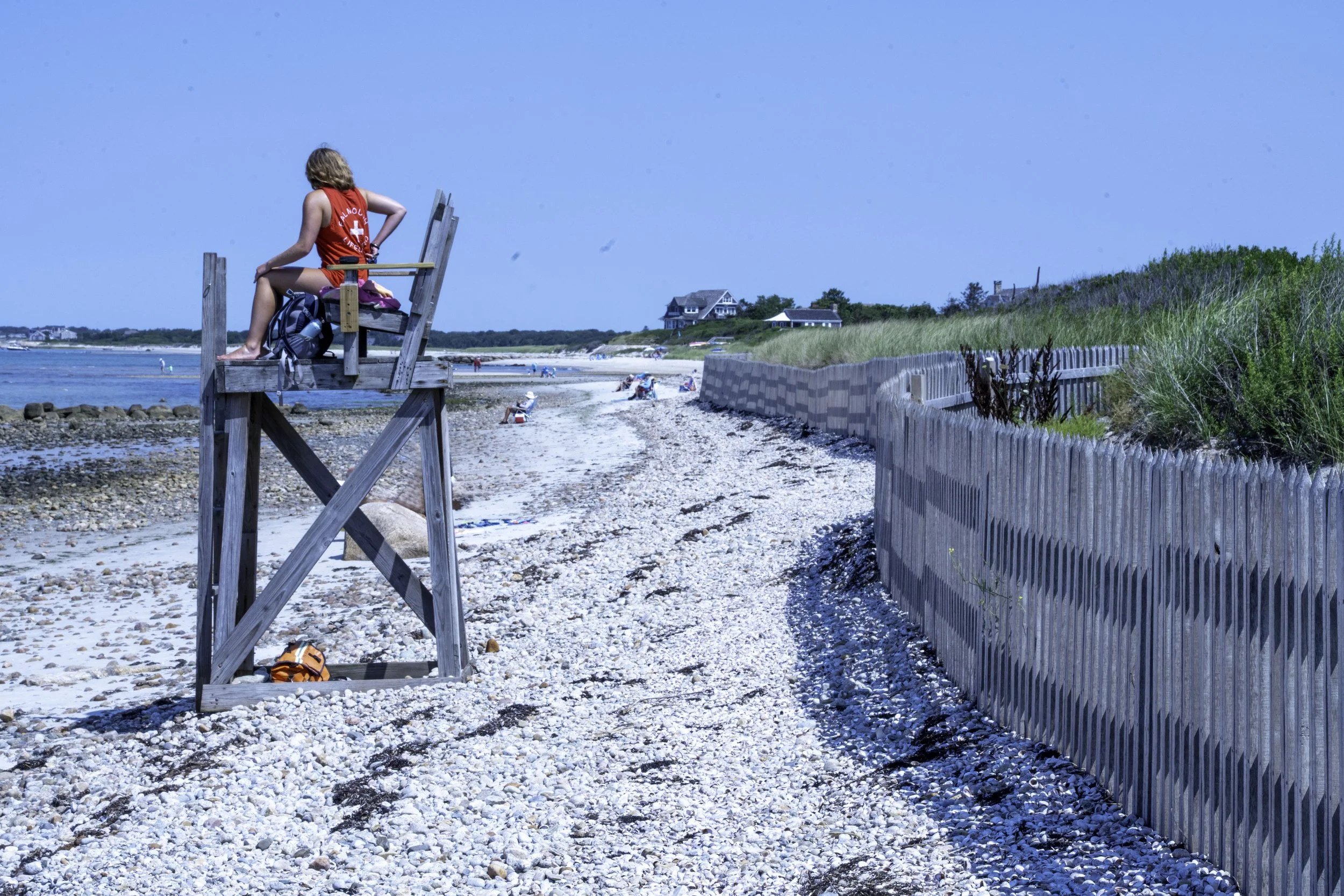
Immediately, Sippewissett residents MaryKay Fox, Greg Nicoll, and Falmouth Conservation Land Manager Mark Kaspyrzyk jump-started the restoration project. This involved building, then erecting, a reinforced fence to protect the southern and middle dunes. The fence would trap sand in place and minimize the loss of dunes from wave action. The dunes would also be restored by adding sand to replenish that lost to erosion and planting beach grass to secure that new sand.
By January of 2023, the project had delivered 62 truckloads sand, some 750 tons, brought in to rebuild the dunes by the town DPW. Under the leadership of Mark, Greg, and MaryKay, with skilled carpenters Bob Skilton and Lew Stern, a dedicated group of volunteers from numerous
Sippewissett neighborhoods jumped in to start building 126 8 foot fence sections. This sturdy fence was installed along the seaward side of the dunes, with snow fencing placed on the backside/parking lot area. Some 50,000 culms of beach grass were planted by the 300
Committee volunteers (30 folks), Scout members #38 & 42 (27 folks), and the Upper Cape Regional School (16 folks) to stabilize the dune system. The Falmouth Department of Public Works was essential to making this project work with their dedication to delivering sand and the numerous days in digging in the post fencing along the 2,000 feet of fencing.
Local businesses also donated their services. This included donations and in-kind work during the weeks of installing fencing. We thank the following local businesses for their contributions to this project: Mid Cape Lumber, Buzzards Bay Coalition, Cape Cod Winery (Peter Orlandella), AutoCamp Cape Cod (Jan Blum), Moore Yacht Sales (Capt. Tyler Noveletsky), and Longfellow Design & Build (Mark Bagosian). Overall, the group raised $17,200 in 7 weeks from 34 donors,and 97 volunteers helped build, install, plant, drill, haul materials needed.
The work was completed in mid-April 2023. It truly was a community effort to protect our precious Wood Neck Beach. Now, two years later in late 2025, the fence has stood the test of time with a well-established, functioning dune habitat. Beach grass has thickly covered the upper dunes, adding more structural integrity to the dune system. As predicted, some sand has eroded immediately behind the fence due to several storm surges, but now a layer of stones has accumulated there, helping to reduce wave action during high tide and adding more physical protection from eroding forces. The fence has also eliminated erosion caused by human foot traffic, allowing the dunes to capture more drifting sand off the beach and enhance the growth of the beach grass and native bushes. This provides for a thriving habitat for native song and white-throated Sparrows, migrating songbirds and Monarch Butterflies, New England Cottontail rabbits, and a host of mammal species.
We hope to begin phase 2, protecting the third and last dune, soon. Time is of the essence to enhance Piping Plover nest habitat and to protect this last special dune habitat.
Stay tuned…